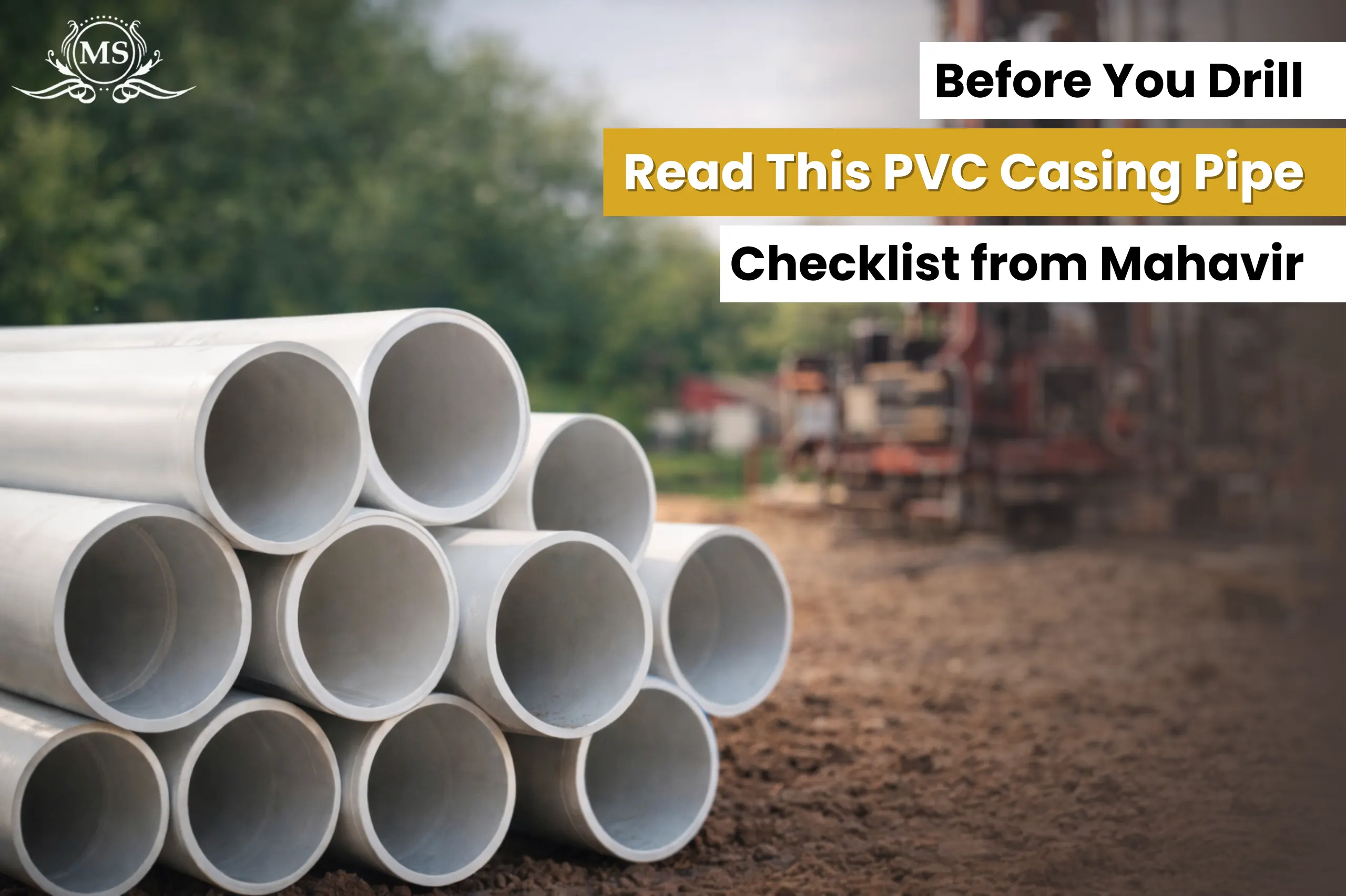
Drilling a borewell is a significant investment. For decades they often served for farms, homes, and industrial units as the primary water source. A borewell’s success however does not just depend on the depth of the drill. Rather it depends on the protective shield that keeps its borehole open. The shield is PVC Casing Pipe. It’s vital to choose the right Casing Pipe PVC to ensure borewell’s longevity. Even the best-drilled well without a high-quality casing can succumb to soil collapse, contamination, or structural failure. Experts at Mahavir Group have compiled essential pre-drilling checklist to guide you and ensure your project stands the test of time.
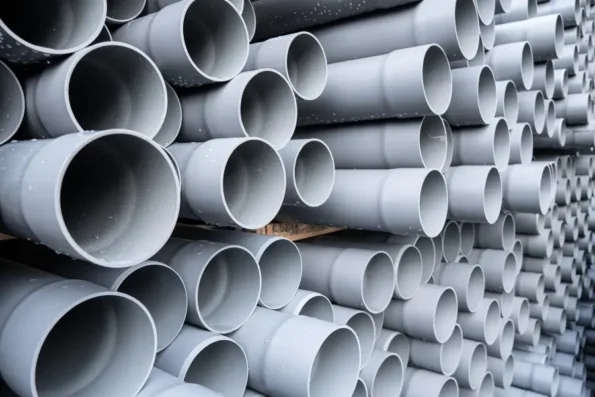
PVC CASING PIPE CHECKLIST
Table of Contents
ToggleHere’s the Mahavir’s checklist for PVC Casing Pipe.
KNOW YOUR GEOLOGICAL DATA
It’s essential to know the ground you are breaking before looking up PVC Casing Pipe price. There are different soil types. They require different pipe ‘weights’ or classes.
- LOOSE SANDY SOIL: Requires heavy-duty casing to prevent the pipe from being crushed by the ‘shifting’ soil.
- HARD ROCK FORMATIONS: Allows for medium-duty casing as some structural stability is provided by the rock itself.
- CORROSIVE OR SALINE WATER: Standard metal pipes will within years rust. This is where Casing Pipe PVC scores high as its chemically inert. This makes it immune to electrochemical reactions.
VERIFY THE PIPE MATERIAL
Most PVC’s by and large are different. Additionally, not all of them in general are created equal. Many budget options use recycled plastic. This however becomes brittle underground. That is the reason why virgin PVC is non-negotiable. PVC Casing Pipes from Mahavir Group are made from high-grade, virgin PVC compounds.
- WHAT MAKES VIRGIN PVC BETTER: Offers superior tensile strength and impact resistance. This ensures the pipe does not crack when pressure is applied by the drilling rig or when during seismic activity the earth shifts.
- LEAD-FREE ASSURANCE: Ensures the pipe is lead-free. They keep the drinking water for domestic consumption non-toxic and safe.
MATCH THE PIPE CLASS TO YOUR DEPTH
Never use a shallow pipe for a deep=well application. Instead opt for a PVC Casing Pipe. It comes in three industry-standard categories.
- CS (CASING SHALLOW): Suitable for depths up to 80 meters.
- CM (CASING MEDIUM): Made for depths up to 250 meters.
- CD (CASING DEEP): Engineered for depths surpassing 250 meters. It features thicker walls to withstand immense hydrostatic pressure.
Always ask for the SDR (Standard Dimension Ratio). If the SDR is lower they generally indicate a thicker, stronger pipe wall.
INSPECT THE THREADING AND JOINTS
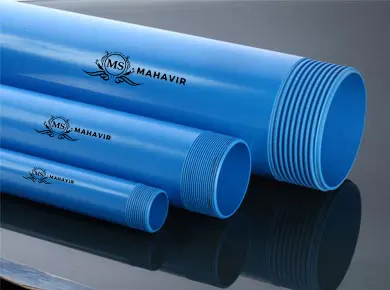
The joint is the weakest point of any pipeline. Now, if the joint leaks, sand and slit will enter the borewell. They eventually damage the submersible pump.
- MALE-FEMALE THREADING: Pipes from Mahavir come with precision-cut threads. They ensure a watertight, ‘lock-and-key’ fit.
- SMOOTH FINISH: Ensure the threads are burr-free. Rough threads can cross-thread during installation. This leads to a tilted casing string, making the pump lowering impossible.
CALCULATE THE ‘REAL’ COST
Always calculate the real cost rather than just the price. The PVC Casing Pipe Price is an important factor. It should be weighed against the ‘Total Cost of Ownership.’
- INITIAL SAVING VS LONG-TERM LOSS: Cheap, low-quality pipe might save you Rs 5,000 today. But if it collapses in three years, the cost to re-drill can cross Rs 1,00,000.
- EASE OF HANDLING: PVC is lightweight when compared to steel. This will help you save to a significant extent during the installation phase on transportation and labor costs.
THE INSTALLATION CHECKLIST
Now you have your Mahavir pipes on-site. Next, just follow these steps during the drilling process.
- USE CENTRALIZERS: Ensure the pipe stays in the center of the borehole. This allows for even ‘grouting’ (filling the gap between the pipe and soil with cement/sand).
- ALIGNMENT CHECK: Ensure the rig is perfectly vertical. Even a slight tilt can make the PVC to ‘bind’ or stress. They lead to future cracks.
- SLOTTED PIPES FOR AQUIFERS: Ensure the use of screen (slotted) pipes at the specific depths where the water-bearing veins (aquifers) is located. They help maximize water yield.
CONCLUSION
Mahavir Group is known for its high-quality PVC Casing Pipe. Over the years, they have perfected the balance between PVC Casing Pipe price and industrial-grade durability.
Their pipes are tested for:
- HYDROSTATIC COLLAPSE PRESSURE: Ensures they do not implode under deep-water pressure.
- IMPACT STRENGTH: Ensures they survive the rough handling of a drilling site.
- FLOW EFFICIENCY: Ensures reduced friction with mirror-smooth internal surface. The pump will work less and last longer.
FAQs
Q. Why is the PVC Casing Pipe Price higher for some models than others?
- A. The price varies based on the pipe’s wall thickness and raw material grade.
- A CD-class pipe is more costly when compared to a CS-class pipe. That is because it uses more virgin PVC to realize the thickness needed to resist ‘hydrostatic collapse’ at extreme depths.
- By investing in the appropriate grade, you can prevent the pipe from imploding under earth pressure. This will save you from the cost of re-drilling.
Q. Is it possible to use a standard plumbing PVC for a borewell casing?
- A. No. Standard plumbing pipes cannot withstand the external crushing pressure of soil and rock.
- Casing Pipe PVC is specifically made with higher stiffness and specialized threading. This ensures the structural integrity and a leak—proof seal deep underground.
Q. What are the signs of a high-quality PVC Casing Pipe?
A. Look for the following aspects when inspecting pipes from Mahavir:
- LEAD-FREE CERTIFICATION: Indicates the water remains for drinking safe.
- PRECISION THREADING: Male and female threads should without force fit smoothly. This will help prevent cross-threading.
- SDR RATING: Lower Standard Dimension Ratio (SDR). They indicate a thicker, more durable pipe wall.
Q. Does the pipe’s color matter?
- A. Most high-quality uPVC casing pipes in the Indian market are blue. They signify their adherence to IS 12818 norms for borewell use.
- Make sure to always check the ISI mark and the class (CS/CM/CD) rather than relying on color alone. They are printed on the pipe surface.