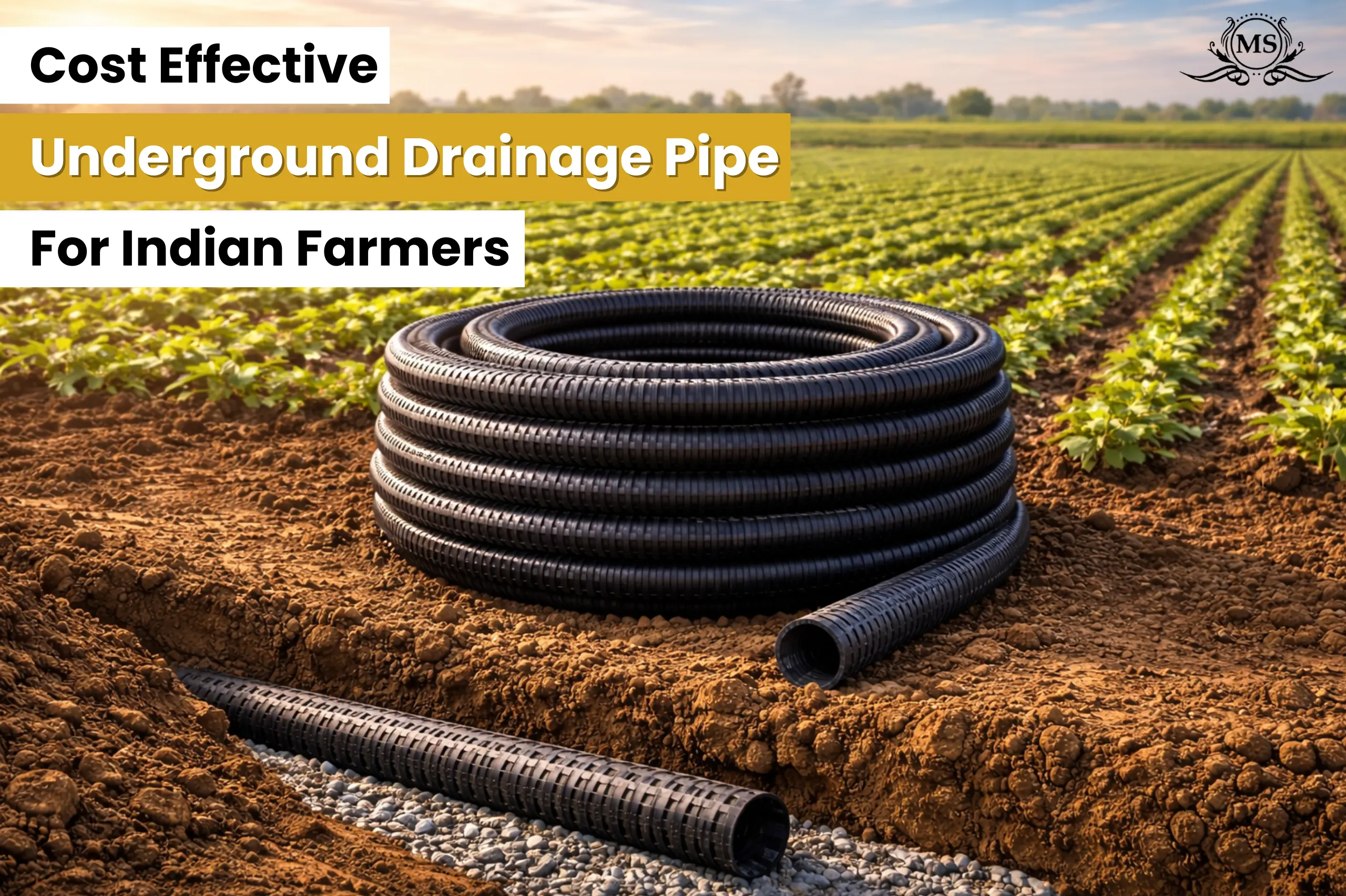
Efficiency is in the ever-evolving landscape of Indian Agriculture not just a goal. Rather, it is a necessity for survival. The challenge of water-logging and salinity as of 2026 still continues to affect millions of farmers across India. Smart farmers to combat this issue are turning toward a reliable solution – Underground Drainage Pipe. Barren waterlogged fields can with implementation of a robust subsurface system be transformed into high-yielding assets. The average Indian farmer’s main concern is striking a balance between quality and cost. Hence, it’s important to identify the most cost-effective underground drainage pipe for Indian farmers. They ensure long-term success.
WHAT MAKES UNDERGROUND DRAINAGE PIPE ESSENTIAL FOR EVERY INDIAN FARMER?
Table of Contents
TogglePoor drainage costs the Indian agricultural sector annually billions. The water when it stagnates in the root zone will choke the plants’ ability to breathe. This leads to root rot and nutrient deficiencies’. Additionally, standing water leads to salt buildup. They eventually make the soil infertile.
The best pipe for underground drainage can solve these issues by:
- LOWERING THE WATER TABLE: Prevents water from reaching the critical root zone.
- IMPROVING SOIL HEALTH: Allows better aeration. Also, facilitates better nutrient absorption.
- EXTENDING CROP SEASONS: Helps fields after heavy monsoon rains dry faster. They facilitate early sowing.
WHAT MAKES UNDERGROUND DRAINAGE PIPE ESSENTIAL FOR EVERY INDIAN FARMER?
Poor drainage costs the Indian agricultural sector annually billions. The water when it stagnates in the root zone will choke the plants’ ability to breathe. This leads to root rot and nutrient deficiencies’. Additionally, standing water leads to salt buildup. They eventually make the soil infertile.
The best pipe for underground drainage can solve these issues by:
- LOWERING THE WATER TABLE: Prevents water from reaching the critical root zone.
- IMPROVING SOIL HEALTH: Allows better aeration. Also, facilitates better nutrient absorption.
- EXTENDING CROP SEASONS: Helps fields after heavy monsoon rains dry faster. They facilitate early sowing.
- BOOSTING YIELDS: Studies reveal that effective drainage can increase crop productivity by 20 to 40 percent.
TYPES OF UNDERGROUND DRAINAGE PIPES FOR AGRICULTURE
You will encounter when searching for the right material, several advantages. This however will depend on your soil type, budget, and local weather conditions. The following details different types of underground drainage pipes.
PVC UNDERGROUND DRAINAGE PIPE
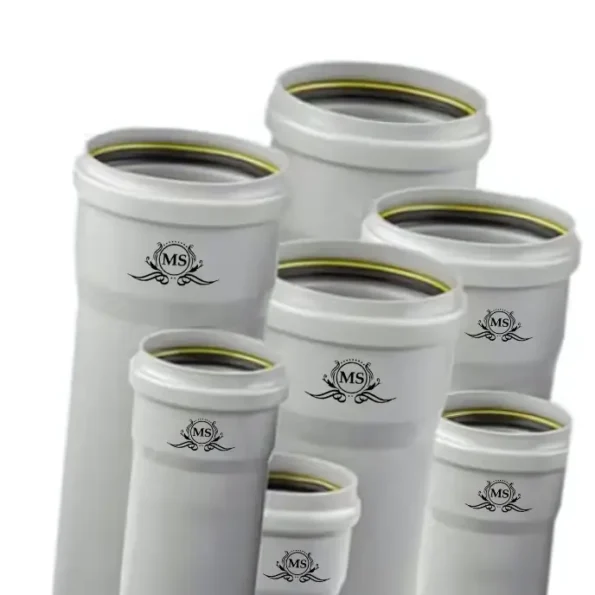
PVC Underground Drainage Pipe is regarded as the most popular choice in India. It’s known for its smooth internal surface and rigidity. This ensures maximum water flow with minimal friction.
- BEST FOR: Standard agricultural fields. Also, areas requiring high-volume water removal.
- PROS: Lightweight and corrosion-resistant. Also, incredibly easy to install using solvent cement.
- ISI STANDARDS: Look for IS:4984 or IS:15328 compliant pipes. They speak of guaranteed quality.
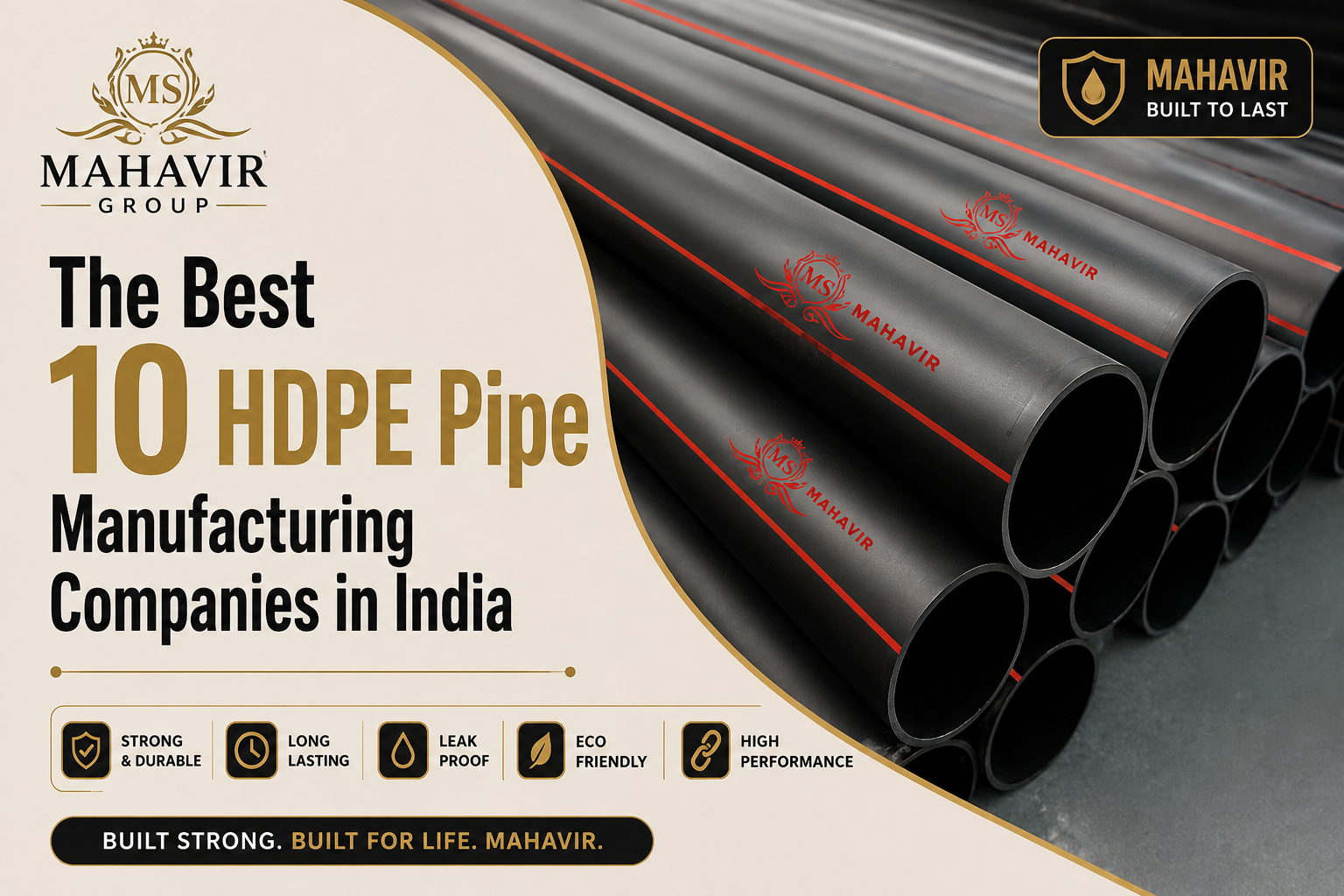
HDPE (HIGH-DENSITY POLYETHYLENE) PIPE
HDPE is regarded as the ‘tough brother’ of PVC. Its immense flexibility allows it to withstand significant ground movement without cracking.
- BEST FOR: Hilly terrains. Or areas with rocky, uneven soil.
- PROS: Available in long coils (fewer joints). Also, is highly resistant to chemicals; and offers a long service life of 50 plus years.
DWC (DOUNLE WALL CORRUGATED) PIPE
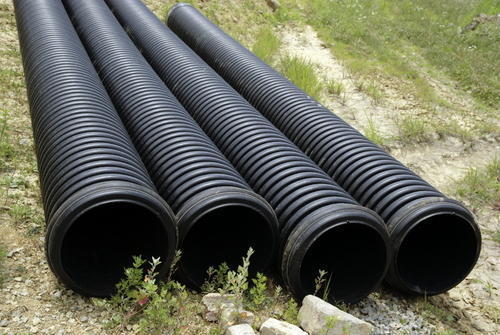
DWC Pipes in 2026 are trending as a highly cost-effective underground drainage pipe. They especially benefit large-scale projects. Featuring a corrugated outer wall for structural strength with a smooth inner wall, the pipe facilitates water flow efficiency.
- BEST FOR: Main drainage lines and areas with heavy vehicle traffic overhead.
- PROS: Uses less raw material. At the same time, maintains high-strength. This makes it cheaper per meter compared to solid-wall pipes of the same diameter.
UNDERGROUND DRAINAGE PIPE PRICE GUIDE (2026)
It is crucial to understand for budgeting the underground pipe price. Prices in India tend to fluctuate on raw material costs and regional availability.
Here are the estimated market rates as of February, 2026:
| PIPE TYPE | COMMON DIAMETER | ESTIMATED PRICE (PER METER) |
|---|---|---|
| PVC (Non-Pressure) | 110 mm (4 inch) | Rs 110 – Rs 150/-. |
| HDPE (PN 6) | 110 mm (4 inch) | Rs 140 – Rs 200/-. |
| DWC (HDPE) | 160 mm (6 inch) | Rs 90 – Rs 120/-. |
| Perforated PVC | 100 mm | Rs 135 – Rs 160/-. |
NOTE: Prices vary by bulk order quantities and brand. Like say, MAHAVIR, Astral, etc.
HOW TO CHOOSE THE BEST PIPE FOR UNDERGROUND DRAINAGE?
Selecting a pipe is not just about the lowest price. It is also about the ‘Lifetime Value.’
Consider the following factors:
SOIL COMPOSITION
CLAY SOILS:
- Opt for Perforated Pipes. For heavy-clay soil.
- Use it with a gravel or geotextile filter. This helps prevent fine soil particles from clogging the system.
SANDY SOILS:
- Opt for smoother PVC pipes.
- Allows water to move quickly toward the outlet.
DEPTH AND LOAD
Choose a pipe with a high Stiffness Class (SN4 or SN8), if you intend to drive over the buried pipes tractors or heavy machinery. A standard thin-walled PVC pipe can under the weight of a 50HP tractor collapse.
CHEMICAL RESISTANCE
The PVC underground drainage pipe or HDPE pipe is ideal for farmers using heavy fertilizers or dealing with saline groundwater. These pipes do not corrode like metal or concrete pipes.
INSTALLATION TIPS FOR MAXIMUM EFFICIENCY
Even the best pipe for underground drainage if poorly installed can fail. Follow these best practices. They help prevent this from occurring. They also ensure your system lasts for decades.
- CORRECT GRADIENT (SLOPE): Ensure a minimum slope of 0.1% to 0.5% (1 to 5 cm drop every 10 meters). Otherwise, water without a proper slope will stagnate inside the pipe.
- TRENCH PREPARATION: Trench should be at least 1 – 1.5 meters deep for agricultural fields. This allows them to stay below the reach of a plow.
- USE FILTER MATERIAL: Surround the pipe if they are perforated pipes with a 4.6 inch layer of gravel or crushed stone. This will act as a filter and also help water to enter the pipe easily.
- LEAK-PROOF JOINTS: Ensure for non-perforated main lines, joints are sealed with high-quality solvent cement or rubber rings. They prevent the roots from entering the pipe and causing blockage.
MAINTENANCE: ENSURING A 50-YEAR LIFESPAN
Underground pipes are no doubt ‘out of sight.’ Still they do require occasional check-ups.
- INSPECT OUTLETS: Regularly clear the discharge points of debris, weeds, or bird nests.
- FLUSHING: Consider Flushing the system with high-pressure water if you notice reduced water flow. They help clear any sediment buildup.
- ROOT MANAGEMENT: Avoid planting directly over the drainage lines, deep-rooted trees.
CONCLUSION
The PVC underground drainage pipe in 2026 remains for most Indian farmers the most balanced option. It offers the right confluence of low-cost; high durability; and easy installation. However, HDPE DWC pipes would be a better option if the budget allows for a long-term infrastructure. They offer superior strength for larger drainage networks. Indian farmers can by investing in a high-quality underground drainage pipe from Mahavir Group, secure the future health of their soil and security of their family’s livelihood.
FAQs
Q. What is an underground drainage pipe? Why is it important for my farm?
- A. It’s a piping system installed beneath the soil surface. It helps to remove excess water and previous water-logging. It’s for Indian farmers essential as it lowers the water table and prevents soil salinity. It also ensures that plant roots have access to oxygen. This directly leads to better crop yields.
Q. What types of underground drainage pipes are available in India?
A. There are three different types of underground drainage pipes.
PVC UNDERGROUND DRAINAGE PIPE:
- Termed the most popular choice. Known for its rigidity, and smooth inner surface.
- Offers high resistance to chemicals.
HDPE PIPES:
- Known for extreme flexibility and strength.
- Ideal for hilly or uneven terrains.
DWC (DOUBLE WALL CORRUGATED) PIPES:
- Possess a corrugated outer layer for high-strength.
- Possess a smooth inner layer for fast water flow.
- Preferred choice for large-scale drainage. This is due to their load-bearing capacity and durability.
Q. Which is in saline or acidic soil, the best pipe for underground drainage?
A. The PVC Underground Drainage Pipe (specifically uPVC) is often regarded as the best in harsh soil conditions.
- Is non-reactive to most acids, chemical fertilizers, and bases.
- Ensures the pipe does not corrode or degrade over time.
Q. What’s in the Indian market, the average underground drainage pipe price?
A. The underground drainage pipe price varies. They vary based on material, diameter, and brand.
On average,
- PVC PIPES (STANDARD): Rs 110 to Rs 160 per meter.
- HDPE PIPES: Rs 140 to Rs 200 per meter. The variation depends on the pressure rating.
- DWC PIPES: Range from Rs 140 to Rs 250 per meter for standard agricultural sizes. Makes them economical for large diameters.
NOTE: Prices are estimates as of 2026. They can vary by region.
Q. Is a PVC underground drainage pipe durable? Are they enough to handle heavy tractors?
- A, Yes, it’s extremely durable. However, make sure to choose the right ‘Stiffness Class.’ Farmers should for areas where heavy machinery like tractors will pass over, look for pipes with an SN4 or SN8 rating. These pipes are specially engineered to withstand without cracking or collapsing, high external pressure.