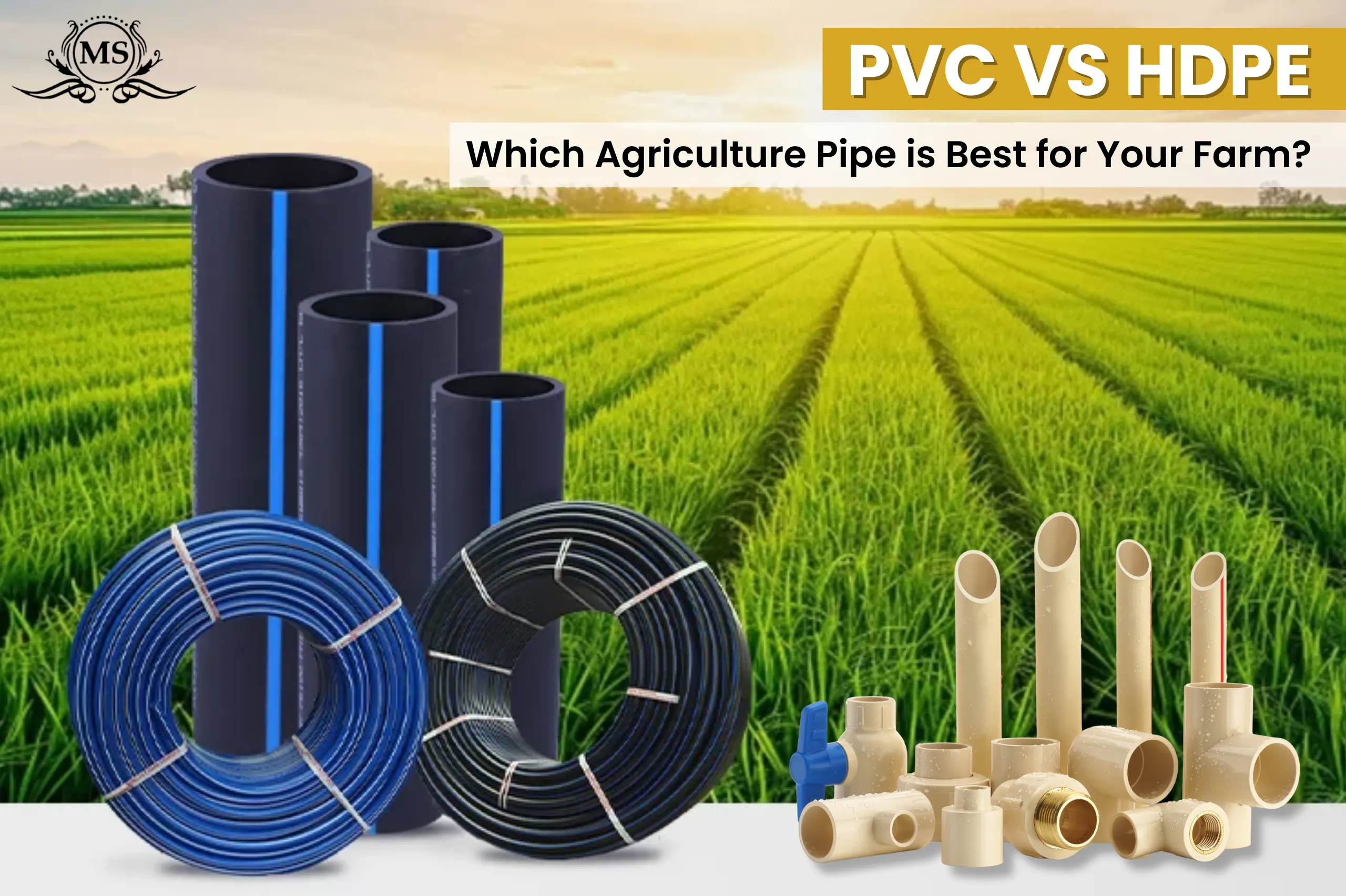
Your farm’s efficiency and long-term return on investment (ROI) can be impacted significantly when making the right selection between PVC and HDPE. Both materials as of 2026 have gravitated to cater to the demands of modern agriculture. But they both serve very different purposes.
The question here is – which agriculture pipe – Agriculture PVC Pipe and HDPE Agriculture Pipe is the right fit for your farm?
They may look identical in many ways to the untrained eye. However their chemical DNA, physical properties, and long-term costs significantly differ.
WHICH AMONG THE TWO – PVC VS HDPE IS BEST FOR YOUR FARM?
Table of Contents
ToggleThe following details will help determine the best fit for your farm’s unique terrain and budget.
PVC (POLYVINYLCHLORIDE)
Termed as the rigid workhorse, it has been for decades the backbone of Indian irrigation. Its strength and affordability for long made it the go-to-choice for permanent structured water delivery systems.
KEY CHARATERISTICS
- HIGH RIGIDITY: PVC is stiff. This allows it to maintain its shape even under high pressure.
- SOLVENT WELDING: Joints are connected with the help of chemical cement. This creates a ‘welded’ bond.
- PRESSURE RESISTANCE: Suitable for high-head applications. Like for instance, lifting water from deep borewells.
WHY IT’S CHOSEN BY FARMERS?
- COST-EFFECTIVENESS: PVC when comparing the initial agriculture pipe price is 10 to 30 percent cheaper than HDPE for similar pressure ratings.
- EASE OF INSTALLATION: No specialized machinery is required. It can be installed by any farmhand with a saw and solvent.
- FLOW EFFICIENCY: PVC has an excellent smooth internal surface. This helps reduce friction. They also allow water to travel faster with less pumping energy.
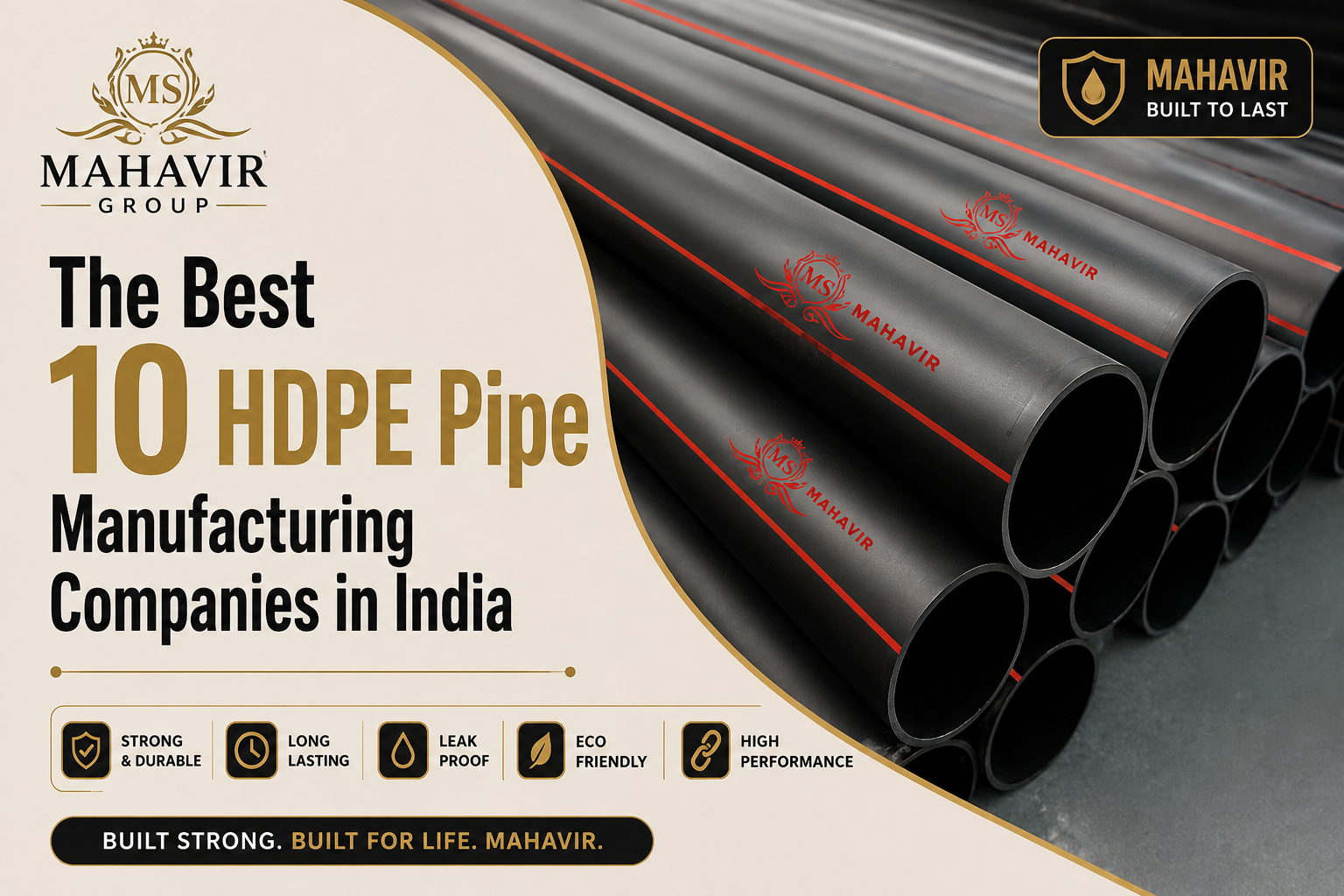
HDPE (HIGH-DENSITY POLYETHYLENE)
Known as the flexible powerhouse, it represents the evolution of agricultural piping. In 2026, it is rapidly gaining ground in regions with rocky soil or uneven hilly terrains.
KEY CHARACTERISTICS
- EXTREME FLEXIBILITY: Can be coiled into long rolls (up to 100 meters or more). This reduces the need for joints.
- HEAT FUSION: Joints are melted together using heat. This makes them ‘monolithic’ (one single piece).
- IMPACT RESISTANCE: Can bounce back. PVC on the other hand can crack if hit by a tractor or dropped.
WHY IT’S CHOSEN BY FARMERS?
- TERRAIN ADAPTABILITY: Can bend if your farm is on a slope or has shifting soil. PVC on the other hand would snap.
- UV STABILITY: Carbon black in HDPE acts in the scorching Indian summers as a natural sunscreen. This helps facilitate smooth above-ground installations.
- ZERO LEAKAGE: Ensures risk of leaks at the connection points is virtually zero. Thanks to HDPE’s heat-fused joints which are as strong as the pipe itself.
TECHNICAL COMPARISION: PVC VS HDPE
| Feature | Agriculture PVC Pipe | HDPE Agriculture Pipe |
|---|---|---|
| Material Type | Rigid Vinyl Polymer | Flexible Polyethylene |
| Joining Method | Solvent Cement (Glue) | Heat Fusion / Compression |
| Flexibility | Low (Needs Fittings for Turns) | High (Bends Around Obstacles) |
| UV Resistance | Moderate (Degrades in Direct Sun) | High (Excellent for Aboveground) |
| Lifespan | 25–40 Years | 50–100 Years |
| Common Use | Underground Mainlines | Drip Laterals, Portable Systems |
AGRICULTURE PIPE PRICE IN 2026
Price in 2026 will be heavily influenced by global crude oil trends and domestic manufacturing shifts under the ‘MAKE IN INDIA’ initiative.
- PVC PRICES: Lower upfront. Expect to pay for a standard 90mm pipe with high-grade uPVC between Rs 120-Rs180 per meter
- HDPE PRICES: Higher upfront cost. This is due to the material’s density. An identical 90mm HDPE pipe may range from Rs 160-Rs 240 per meter.
Don’t just look at the purchase price. Rather, factor in the installation cost. HDPE’s long coils indicate lesser fittings and less labor. This can at times bridge the price gap
WHICH ONE IS BEST FOR YOUR FARM?
OPT FOR PVC IF:
- You are installing a permanent underground mainline.
- You are on a tight initial budget and seeking a cost-effective piping option.
- You are installing borewell column pipes, where vertical rigidity is an essential.
- Your farm is relatively flat and the soil is stable.
OPT FOR HDPE IF:
- You need to lay pipes aboveground where they’re exposed to sunlight.
- You are setting up a Drip Irrigation system. HDPE laterals are superior.
- You like to have a ‘set it and forget it’ system to last for your children’s generation.
- Your terrain is rocky, uneven, or hilly.
MAINTENANCE AND LONGEVITY
Sustainability in 2026 is major focus area. Both pipes, PVC and HDPE are recyclable. However their maintenance requirements differ.
- PVC MAINTENANCE: Check joints annually. Solvent bonds can due to ground shifts or extreme temperature cycles occasionally weaken.
- HDPE MAINTENANCE: Virtually maintenance-free, once fused. However, make sure the fusion was done by a trained and certified technician. That’s because the ‘cold joints’ are for HDPE the only common failure point.
CONCLUSION
In the PVC VS HDPE comparison, there is no one specific winner. Only the best agriculture pipe matters for your specific needs. Agriculture PVC pipe still matters for a standard, budget-conscious farm in the plains of Madhya Pradesh or Punjab. Similarly, for the orchards of Himachal Pradesh or the high-tech or solar-powered farms of the Deccan Plateau, the HDPE Agriculture Pipe remains the best option for quality ROI. Mahavir Group is a leading supplier of industrial piping solutions across India. They offer a comprehensive array of high-grade PVC and HDPE agriculture pipes with options for diverse requirements.
FAQs
Q. Which is more durable from among the two – Agriculture PVC Pipe OR HDPE Agriculture Pipe?
A. Both are durable. However they handle stress differently.
- Agriculture PVC Pipe is a rigid vinyl polymer. This makes it incredibly strong under constant pressure. But potentially brittle if exposed to heavy impact or extreme cold.
- HDPE Agriculture Pipe is on the other hand a flexible thermoplastic. It can without cracking withstand ground shifts, tractor movement, and even freezing temperatures.
Q. In 2026 is there any huge difference in the Agriculture Pipe Price?
A. Yes, there is. The initial agriculture pipe price for PVC is 15 percent to 25 percent lower than HDPE. However, the total cost of installation must be considered.
- PVC: Lowe-per-meter cost. But requires more fittings (elbows, tees) and chemical solvent for joints.
- HDPE: Higher per-meter cost. But its flexibility allows it to be coiled in long lengths (reducing joints). Additionally, it can be heat-infused which often lowers for large-scale projects labor costs
Q. Which pipe is better for Underground VS Overground?
A.
- UNDERGROUND: Both work well. But Agriculture PVC Pipe for deep underground mainlines is the traditional choice. Its rigidity gives it a superior edge.
- ABOVE-GROUND: HDPE Agriculture Pipe has the edge in this category. Most HDPE pipes in 2026 are made with carbon black, a natural UV stabilizer. It prevents the pipe from becoming brittle under the intense Indian sun. PVC on other hand if left exposed for years can degrade and crack more quickly.
Q. Which pipe offers better water flow efficiency?
- A. Agriculture PVC Pipe has a slightly smoother internal ‘bore’ (surface). This helps to reduce the loss of friction. Your pump will not have to work that hard to push water long distances. The difference for most standard irrigation needs in energy consumption between PVC and HDPE is negligible.