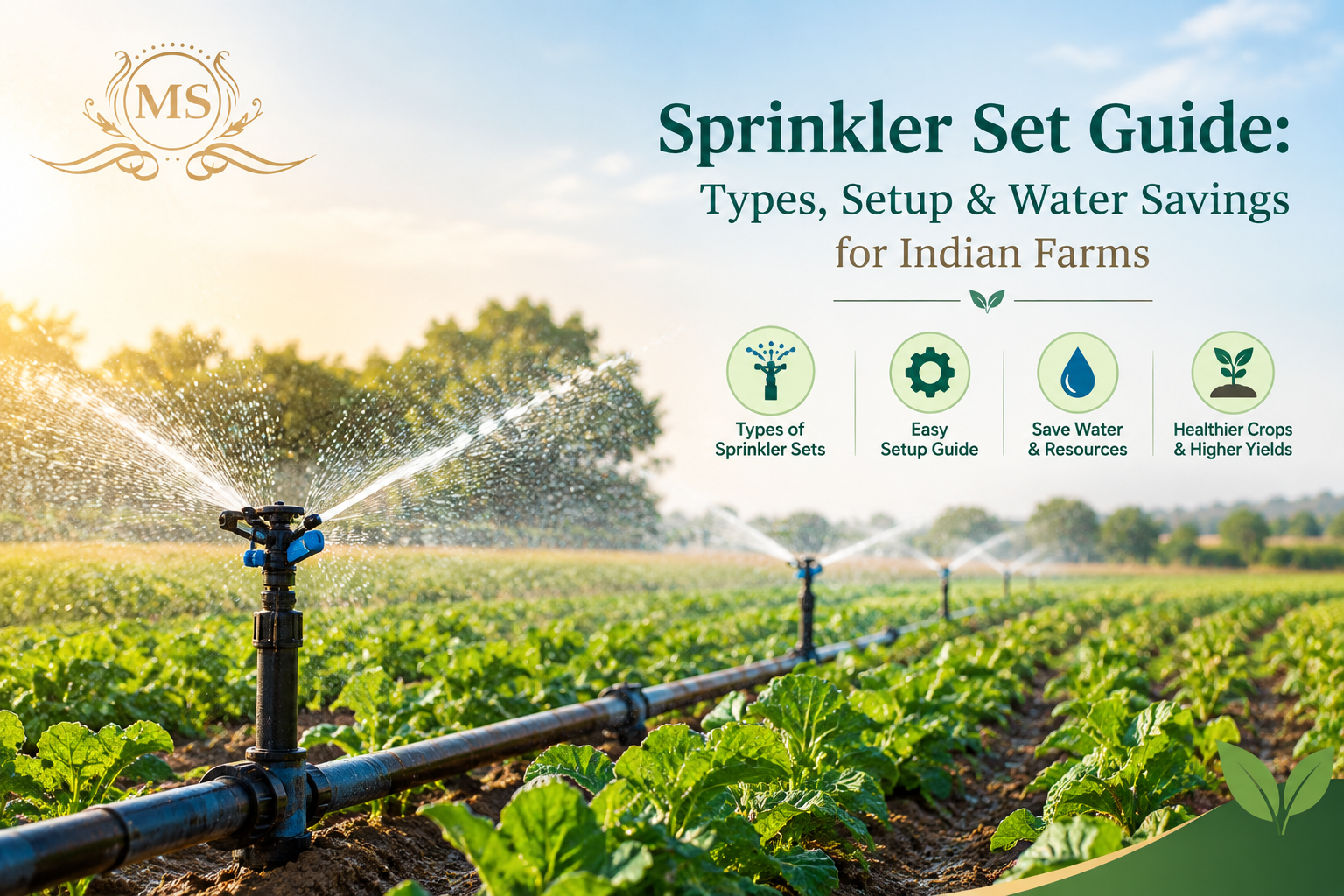
If you’re trying to stretch every drop of water further this season, a sprinkler set is one of the smartest upgrades you can make on your farm. This guide covers everything you need before you buy or install one: the different types of sprinkler set suited to Indian farms, how a sprinkler pipe set actually comes together in the field, the water savings you can realistically expect once you move away from flood irrigation, and what sprinkler set price to budget for based on your land size. We’ll also walk through installation basics, mistakes farmers commonly make, and how to match the right setup to your soil, crop, and water source. By the time you finish reading, you’ll know exactly which system fits your farm and your budget. Let’s get into it.
What Is a Sprinkler Irrigation System?
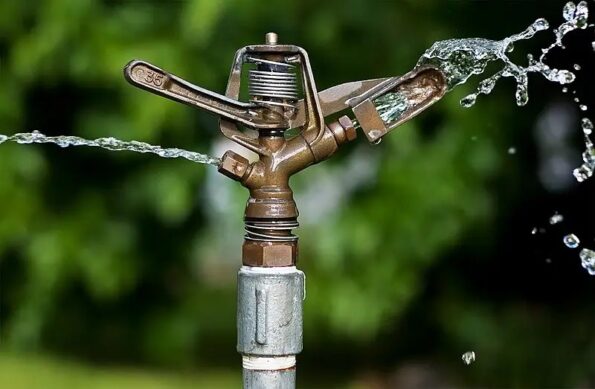
Think of a sprinkler irrigation system as artificial rain. Water moves under pressure through a network of pipes and comes out through sprinkler heads, some rotate, some stay fixed, spraying the field in whatever pattern you’ve set up. That’s really the whole idea behind it.
Unlike flood irrigation, where water runs freely across the soil and a large part of it seeps away or evaporates before the roots even use it, sprinklers apply water where and when the crop needs it. This matters a lot in states like Rajasthan, Maharashtra, and Gujarat, where groundwater tables keep dropping and every liter counts.
Farmers use these systems for wheat, groundnut, vegetables, pulses, sugarcane, and even orchards. The system works on flat land as well as slightly uneven terrain, which is more than you can say for flood irrigation.
Types of Sprinkler Set for Indian Farms
Not every farm needs the same setup. Your choice depends on farm size, crop type, water source, and how much you’re willing to spend upfront. Here’s a quick breakdown:
Type | Best For | Key Feature |
Portable sprinkler pipe set | Small to medium farms | You move it yourself between fields, cheapest to start with |
Semi-permanent system | Medium to large farms | Mainline stays buried, laterals shift as needed |
Permanent system | Large commercial farms, orchards | Fully buried, almost nothing to set up day to day |
Mini/micro sprinkler set | Vegetable and horticulture plots | Fine spray, low flow, gentle on water use |
Sprinkler Pipe Set for Small and Medium Farms
Most farmers working under 5 acres end up with a portable sprinkler pipe set, and it’s not hard to see why. There’s nothing to bury and nothing permanent about it, you lay it out, water that section, then pack it up and shift it once you’re done. It usually includes HDPE or PVC pipes, sprinkler nozzles, connectors, clamps, and end caps. You lay the pipes out in rows, connect the sprinkler heads, and shift the whole set to a different section of the field once that patch has been watered.
This type suits farmers who grow multiple crops across smaller plots and want flexibility without a huge investment. Setup takes an hour or two once you know the layout, and you don’t need to dig trenches or lay anything permanently.
Permanent and Semi-Permanent Systems
Larger farms and orchards often go for semi-permanent or fully permanent systems. Here, the mainline stays buried underground, and only the sprinkler heads sit above the surface, or in some cases, the entire network is fixed in place. You get uniform coverage across large areas without moving pipes daily, though the upfront cost runs higher and installation needs more planning.
How to Set Up Your System Step by Step
Setting one up isn’t as technical as it sounds. Here’s roughly how it goes:
- Walk your field before you buy anything. Look at the slope, the soil, and where your water is actually coming from. Skip this and you’ll likely end up with a system that doesn’t fit your land.
- Work out how much water your crop actually needs, then size your pump and pipe diameter around that number, not the other way round.
- Run the mainline out from your water source, a borewell, canal, or open well, whatever you’ve got, to the field.
- Branch the lateral pipes off the mainline. These are what actually carry water out to each sprinkler head.
- Space the sprinkler heads based on how far each nozzle throws water. Most standard setups work on an 8×8 or 10×10 meter spacing.
- Turn the pump on and check the pressure. Look for leaks, weak spots, or uneven spray before you trust it with the whole season.
Most farmers handle this themselves with basic tools. Bigger or trickier layouts are where getting professional help actually pays off.
Water Savings You Can Expect
This is usually the number farmers care about most. Compared to flood irrigation, a well-set-up sprinkler system can cut water use by 30 to 50 percent, depending on your soil and crop. Sandy soils in particular lose a lot of water to seepage under flood irrigation, so the savings there tend to be even higher with sprinklers.
Beyond the water bill, you also save on:
- Electricity, since you’re running the pump for shorter, more targeted cycles
- Labor, because you’re not manually directing water across uneven fields
- Fertilizer loss, as fertigation through sprinklers reduces runoff compared to flood methods
Crop yield often improves too, simply because water reaches the root zone more consistently instead of pooling in some patches and starving others.
Sprinkler Set Price in India
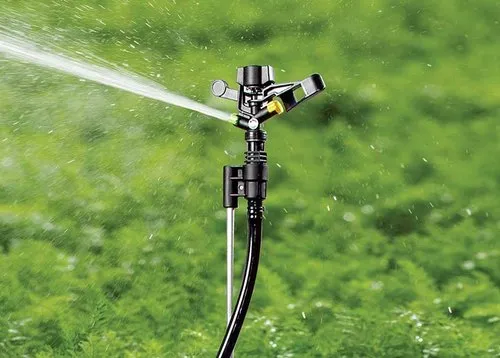
Sprinkler set price varies quite a bit depending on the type, pipe material, coverage area, and brand. Here’s a rough idea of what to expect:
- Portable sets for small farms: ₹15,000 to ₹40,000 for a basic setup covering 1 to 2 acres
- Semi-permanent systems: ₹50,000 to ₹1.5 lakh, depending on pipe length and pump capacity
- Permanent systems for large or commercial farms: ₹2 lakh and above
A few things push the price up or down: HDPE pipes cost more than standard PVC but last longer, pump horsepower affects both price and running cost, and the number of sprinkler heads you need scales with your field area. Government subsidy schemes under micro-irrigation programs can bring your actual cost down significantly, so it’s worth checking what’s available in your state before you finalize a budget.